“Purpose-Built for Happiness”: Panic’s Playdate as a Cozy Platform
by Jaroslav ŠvelchAbstract
Following the growing body of literature on cozy games and platform studies, this article analyzes the novel, crank-controlled handheld Playdate console as a case of a cozy platform. It draws from (a) the promotional materials published by Playdate’s producer Panic, (b) the 40 initial games for the device and (c) notes about the user experience produced by the walkthrough method. Using qualitative analysis, it identifies features of cozy game aesthetics in Playdate’s design, its promotion, its games and its distribution platform. It argues that Playdate embodies the ambiguities and contradictions of cozy aesthetics by offering, on the one hand, consumerist escapism and nostalgia, and on the other hand, space for social critique and “resistance through care.” While Playdate uses an app store (called the Catalog) akin to Steam, it subverts the logic of platform capitalism by trying to create a curated, boutique distribution platform that offers an inviting environment for hobbyists and semi-professional creators. The article concludes that Playdate is a valuable social experiment, showing that a platform can be cozy, with all the contradictions it entails.
Keywords: Playdate, Panic, cozy games, platform studies, indie games, handheld gaming, platform capitalism, nostalgia, retro gaming
Introduction
When the tiny, yellow, handheld “Playdate” gaming console was announced in 2019, it was advertised as a unique, “truly different” device that would deliver “fun and delight” and “add a little brightness to your life” [T1][1]. The 20-page reveal story published by Edge magazine mentioned that Playdate was “purpose-built for happiness,” and at the same time “purposefully countercultural” [T17, pp. 58, 65]. The device’s producer, the US company Panic, originally intended it as an homage to Nintendo’s Game & Watch devices, with the twist that Playdate would get remotely updated with new games that would comprise a “season.” The early coverage and press releases portrayed it as a cute and quirky object, in part thanks to its unorthodox crank controller (see Figure 1). Within two years of its 2022 release, over 70,000 devices have been sold to customers [T2], creating a niche but substantial audience. Far from a mere toy, Playdate has become a platform of its own, with third-party developers selling games through a dedicated store called Catalog. Despite becoming more alike other gaming platforms, Panic maintains the image of Playdate as a platform that is friendly and cozy, a micro-utopia of cute, accessible, inclusive and distraction-free gaming.
This article will bring together the literature on cozy games and platform studies to study Playdate as a cozy platform. It aims to enrich the understanding of coziness in games by applying the concept to a whole platform, and to enrich platform studies by investigating how a hardware producer can shape the aesthetic and affective appeal of their platform. Additionally, it addresses the lack of research on Playdate, a minor but unique and theoretically intriguing console. I will interpret Playdate as a part of the increasingly prominent trend of “cozy games” and “cozy gaming.” Throughout the article, I will show that Playdate embodies the ambiguities of the cozy aesthetics, which can be understood both in the conformist sense of escapist fun and the critical sense of “resistance through care” (Waszkiewicz & Tymińska, 2024). On the one hand, the platform offers escapist fun and nostalgia for 1980s and 1990s gaming, on the other hand it provides an idealistic alternative to major platforms and a manifestation of the “Utopian impulse” (Jameson, 2005; see Cartlidge, 2025). As both gaming and social media platforms are increasingly associated with toxicity, exploitation and oligopolist tendencies (Gray, 2012; Thorhauge, 2023), Playdate is a social experiment in creating a friendly, small-scale console for an indie game audience.
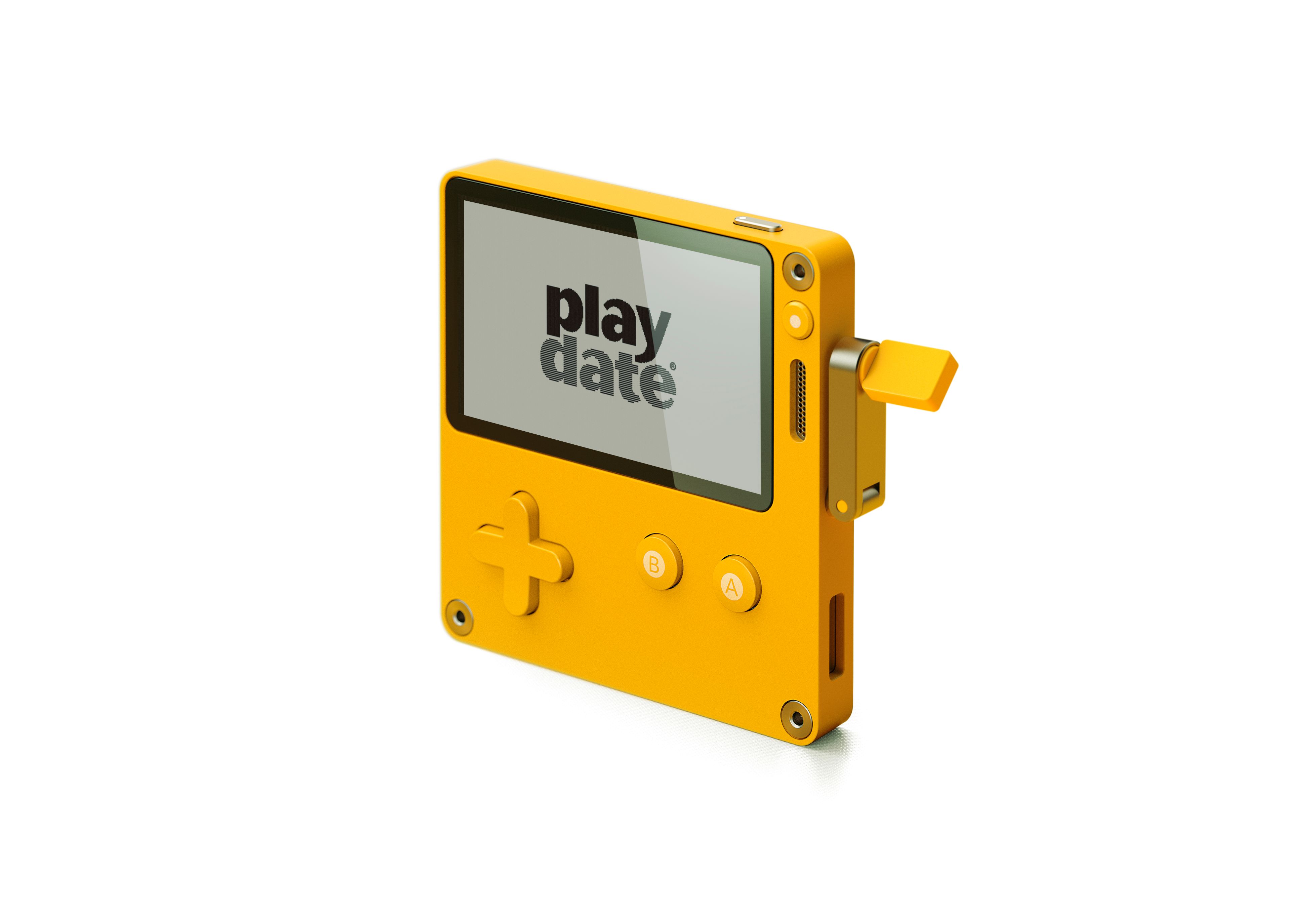
Figure 1. A promotional image of Playdate from the 2019 press release. Click image to enlarge.
Understanding Cozy Games
In recent years, the term cozy games has gained considerable traction in the game industry, game journalism and game studies. The go-to examples of this trend are Stardew Valley (ConcernedApe, 2016) and the Animal Crossing series as well as various other farming, cooking and coffee making games. As Waszkiewicz and Tymińska have put it, the aesthetic of cozy games is instantly recognizable: “The colors are bright and/or pastel, the shapes are round, the characters are adorable…, the music is soft, positive, and upbeat.… there are no jump scares, timed events, or competitiveness; and failure, even if it is present, does not sting” (Waszkiewicz & Tymińska, 2024, p. 8). The term itself was first systematically defined in a report by the game designer think tank Project Horseshoe (Short et al., 2018). The report defines coziness in games as a combination of three elements: safety (or “absence of danger and risk”), abundance (meaning that the player does not struggle for resources and may work on higher needs such as deeper relationships, self-actualization, or belonging) and softness (meaning visual and sonic cues suggesting a low-stress environment).
The ideas behind these definitions are not entirely new. In fact, the category of cozy games might be seen as a rebranding of the category of casual games, theorized by Jesper Juul (2009). According to Juul, casual game design presupposes positive fictions, usable design (meaning accessibility for non-gamers), juiciness (meaning constant and pleasant feedback), interruptibility (meaning that the game can be played in short sessions) and lenient punishments for failure (Juul, 2009, p. 52). A part of the reason for the rebranding might be the fact that many casual game series originating around 2010 (such as Angry Birds and Candy Crush Saga) introduced monetization techniques such as microtransactions, whose disruptive and exploitative nature is at odds with the ideals of positive, cozy experiences. Nevertheless, both casual games and cozy games have been understood in opposition to big-budget games for competitive hard-core players, which cater primarily to the demographic of young men. Cozy games, on the other hand, are often (although not exclusively) smaller-scale project developed by independent studios, making them seem more authentic and wholesome (Scully-Blaker, 2024; Waszkiewicz & Bakun, 2020).
Within game studies, coziness has been picked up around 2020 as a useful if ambiguous aesthetic category (Waszkiewicz & Bakun, 2020). In part, cozy games have been commended for mainstreaming inclusive design approaches and finding alternatives to mechanics and narratives based on masculine power fantasy. According to Waszkiewicz and Tymińska, cozy games embody “resistance through care” by offering opportunities for rest and comfort amidst the anxieties of late capitalism (Waszkiewicz & Tymińska, 2024). More recently, Krzywinska et al. (2025) have expanded the discussion to coziness in games more generally, independent of particular genres and design patterns. They connect coziness to cheap and portable platforms; to the ability to play “sitting on a sofa in a position of ease” (Krzywinska et al., 2025, p. 7). Like mobile platforms or the Nintendo Switch, Playdate is a good fit for sofa gaming. In this article, I will take a similarly broader approach to coziness, tracing it not only in individual games but also in the whole platform.
Much of the literature has also revealed inherent contradictions of cozy games. As their mechanics often involve growth and accumulation, they “re(create) neoliberal systems” (Bódi, 2024, p. 53). They strive to provide comfort but “comfort is a conservative affect, it is an enemy of change and, through its inaction, a reification of those material conditions that make many seek out wholesome games to begin with” (Scully-Blaker, 2024, p. 142). As a result, cozy games have been critiqued for facilitating “escapist nostalgia” and “consumerist retreat into coziness” (Andiloro 2024, 88). This critique aligns with literature on another, related, aesthetic category -- that of cuteness, which is likewise often linked to “conservative nostalgia” (Dale et al., 2017, p. 9).
The nostalgic aspect is especially pertinent to Playdate, which aims to recreate the experience of gaming in the 1980s and early 1990s. In this regard, it is similar to UFO 50 (Mossmouth, 2024), a compilation of 50 games purportedly made in the 1980s. Drawing from the concepts introduced by Fredric Jameson (2005), James Cartlidge argues that UFO 50 goes beyond “nostalgia mode” of fetishizing the past and manifests the “Utopian impulse” thanks to its “celebration of creativity, collaboration, and risk-taking, as well as its critique of the modern gaming industry’s reliance on corporate interests and marketability” (Cartlidge, 2025, p. 14). Like UFO 50, Playdate aims to revive some of the positive aspects of 1980s game production, such as thematic diversity, unpredictability and a lower barrier of entry into the industry. But while UFO 50 features games made by a fictional company for a fictional console, Playdate allows real developers to make games for a real handheld. In the process, the platform aims to carve out a cozy environment for the developers. In the latter part of this article, I will focus on the potential coziness of game production, an aspect of cozy games that has not yet gained significant scholarly attention.
Playdate as a Platform
Although Playdate was -- at least initially -- not advertised as a platform, it clearly is one both in the sense of a hardware standard (Montfort & Bogost, 2009) and a distribution and monetization infrastructure (see Nieborg & Poell, 2018; Thorhauge, 2023).
The former meaning of the term platform has been established by the Platform Studies book series (Montfort & Bogost, 2009). Although the series’ aim is more general, most books within the series are dedicated to historical hardware platforms, covering their history, technical design and cultural impact, with an emphasis on how creators struggle with each platform’s limitations and take advantage of their affordances. The platform studies approach has been criticized for worshipping legendary, idealized objects at the expense of bodies and politics (Anable, 2018). Nevertheless, Playdate lends itself very well to the platform studies treatment. In a sense, the device reifies nostalgic platform worship; it invites game developers to work with unique hardware constraints and affordances, as it was common in the 1980s and 1990s. Playdate has a tiny 400x240 1-bit black-and-white display, a crank controller and a software development kit that supports the C and Lua programming languages as opposed to more popular ones like C++ or Python. Because of these quirks, it is next to impossible to port existing games to Playdate, making the library of games unique [2]. These limitations invite comparisons to projects like Pico-8, a virtual quasi-8-bit machine, which has attracted a lively community of developers. But while Pico-8 is officially branded as a “fantasy console” (Lexaloffle, n.d.), Playdate is a real one.
Unlike mass-market consoles such as the PlayStation 5 or the Nintendo Switch, which compete to be the player’s primary gaming device, Playdate is promoted as complementary to other systems. Due to Panic’s limited capital and capacity, it is produced in small runs, making it an example of a “minor platform” that provides an alternative to mainstream game industry practice (Nicoll, 2019). One could also call it a “boutique” platform, as it eschews mass market appeal for an “aura of uniqueness” (Pimlott, 2007, p. 4) that attracts a smaller but more dedicated audience of indie game productions (see Parker, 2020). This, in turn, means that larger publishers are not interested in publishing games for the platform, making it a sole domain of indies and hobbyists.
The other meaning of platforms is tied to their role as markets, infrastructures and organizational forms. Similarly to Steam, the Playdate Catalog is “a multi-sided market” that connects game producers with game players and facilitates financial transactions -- the purchases of Catalog games (Thorhauge, 2023). As a platform owner, Panic curates the Catalog, reserves the right to decline any submitted software, and receives 25% revenue share from each sale [T2]. While selectively curating the Catalog, the company also explicitly invites players to “sideload” any piece of software they obtain through other sources, including the software distribution platform Itch.io. This combination of curatorship and openness is rare on today’s games market, although it has precedents in the realm of personal computers, including the Atari Program Exchange, a curated list of mail-order software (including games) for Atari’s 8-bit computers, written by hobbyists and small-time developers and published by Atari (AtariArchives.org, n.d.). The combination of openness and curatorial control allows Panic to nurture an active creator community, while steering the Playdate Catalog towards a coherent aesthetic. The curatorship of the Catalog contributes to the cozy appeal of the platform, which will be analyzed in the following sections.
Material and Methodology
The aim of this article is to identify and interpret the elements of cozy aesthetics in the Playdate platform, in its games, and in the way the device is represented by Panic’s marketing. It draws from the following types of material:
- Panic’s Playdate-related PR and marketing materials, including press releases, YouTube videos, developer-facing resources and selected episodes of the Panic-produced official Playdate podcast. Together, I gathered 18 primary texts that were analyzed more closely (see Appendix 1). The primary texts are referred to in the article using [Tx, p], where x is the number of the text and p is a page number if available. These were complemented by supplementary material (including developer interviews) that was consulted on a selective basis.
- The entire Season 1 of Playdate games (24 titles) plus the 16 launch titles of the Playdate Catalog, released in 2023 when the service went live (see Appendix 2). Following the recommendations from game analysis literature (Fernández-Vara, 2015), I documented each game's Catalog descriptions, modes, narratives, mechanics and representations.
- Notes about the platform’s affordances and user experience features obtained using the walkthrough Introduced by Light, Burgess and Duguay in 2018 for the study of apps, this method “involves the step-by-step observation and documentation of an app’s screens, features and flows of activity” (Light et al., 2018, p. 882). While originally designed to study apps, it can also be applied to the study of a platform’s software environment. In addition to software walkthrough, my notes also contain autoethnographic observations about Playdate’s materiality, ergonomics and form factor, informed by over two years of user experience [3].
The material was analyzed qualitatively, using a combination of deductive (thematic analysis) and inductive (analytic induction) methods (Ayres, 2008; Preissle, 2008), while taking into account the multimodal nature of the material. First, I coded the material to identify some of the basic pre-defined features identified in literature on cozy and casual games: cuteness, nostalgia, cozy or casual mechanics (meaning the presence of abundance, safety, interruptibility, or mechanics inspired by other cozy games), accessibility and mimetic controls. At the same time, I was creating new codes inductively, noticing themes that occur in the material but are at tension with coziness. These new themes were commerce, related to platforms as profit-driven businesses and critique, referring mainly to political and social critique. It has also become clear that cozy and casual mechanics are sometimes at odds with the nostalgic appeal of the platform and its games. In the following sections, I will first describe the cozy elements in Playdate’s hardware and software and then discuss the three abovementioned tensions.
The Shades of Playdate’s Coziness
Hardware and operating system
The cozy appeal of Playdate starts with its striking product design, inspired by the 1980s and 1990s consumer electronics, such as the Sony Walkman Sports. As Panic founder Cabel Sasser has put it, the company wanted to create “something that felt fun and cute and cool, and did not take itself too seriously” (Panic, 2022a). The yellow color directly mimics the color of Nintendo Famicom Disk System cartridges from the 1980s and it is supposed to evoke positive, fun feelings. As Panic designer Neven Mrgan [4] puts it, yellow (and purple, which was the color of the initial Playdate cover accessory) are “fun, summery colors… They’re also colors that most companies out there are… too cowardly to use in their branding” [T13]. The cuteness is compounded by the console’s tiny size. Both the launch video and promotional photos emphasize that the whole device fits into one’s hand (see Figure 2). In my experience, this makes Playdate somewhat inconvenient to control for large-handed people.
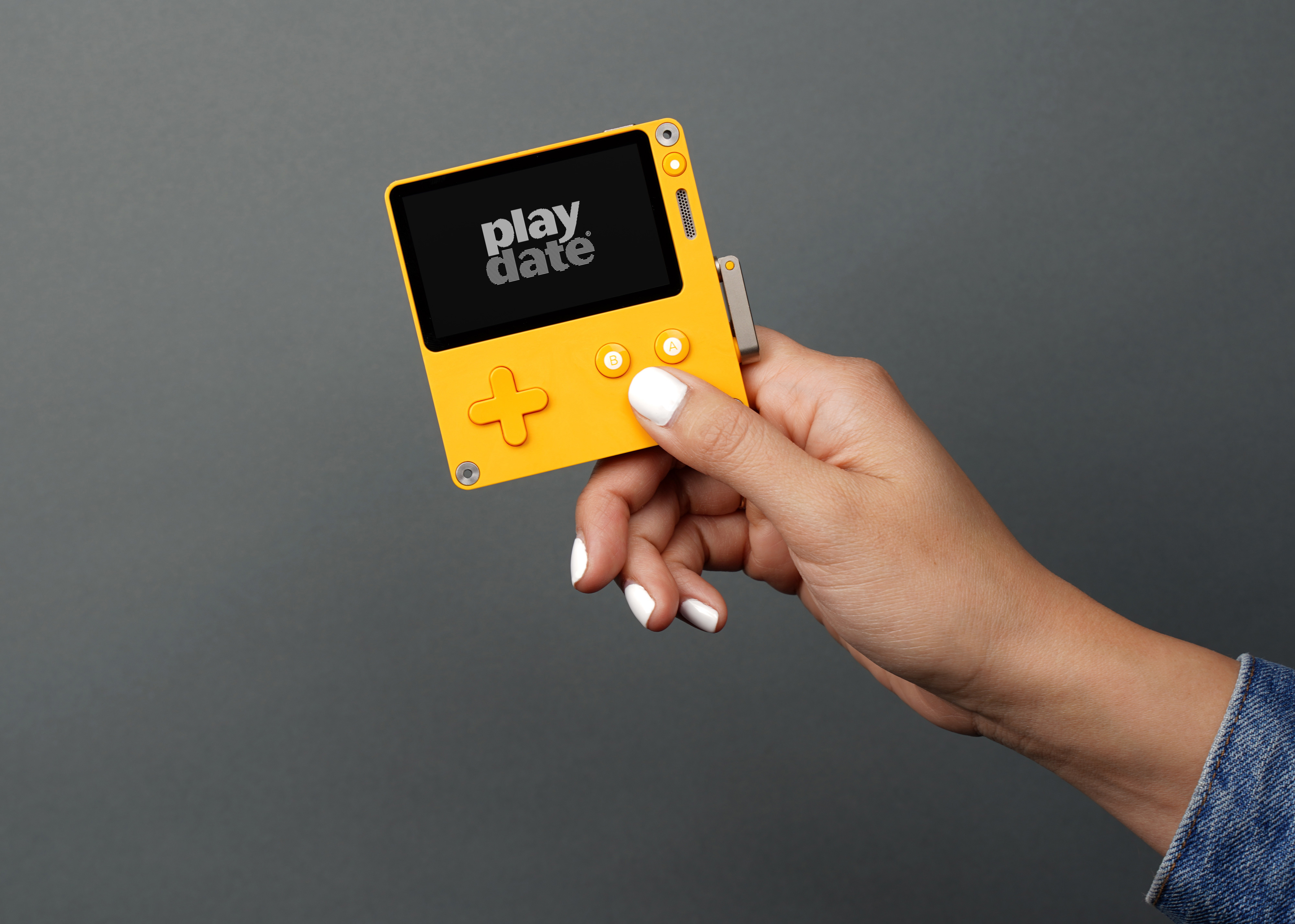
Figure 2. A promotional image of a model holding the Playdate console from the 2019 press release. Note the size of the device. Click image to enlarge.
The black-and-white graphics of the Playdate screen invite comparisons to the Nintendo Game Boy, the 1989 console that is perhaps closest to Playdate in terms of its aesthetics and projected uses. The Playdate display is sharp and high-contrast, but -- similarly to the Game Boy -- it is not backlit. As a result, it requires the exact opposite lighting conditions than mobile phones or the Nintendo Switch, underlining Playdate’s uniqueness. The Playdate is a device that is best used during the day, ideally in direct sunlight -- contradicting the stereotypical image of hardcore gamers playing in darkened rooms, illuminated by the blue light from their TVs and monitors.
Playdate’s most distinctive feature is the crank, which is deeply integrated into the design of Playdate’s operating system and many of its games. It was suggested by Jesper Kouthoofd of Teenage Engineering, a Swedish electronics company that took part in the device’s product design. The crank has its precedents among the rotary analog controllers of the 1970s but Kouthoofd explains its inclusion as a part of his company’s struggle against “touch-screen psychosis” brought about by mobile phones and tablets [T13]. The involvement of a Swedish company provides a discursive link to the concept of “hygge,” a specifically Scandinavian (originally Danish) idea of coziness and homeliness (Waszkiewicz & Bakun, 2020). The crank also signals quirkiness and indie aesthetic; as game designer Bennett Foddy, the author of Season 1 game Zipper, opined: “It’s a position statement. You can't see that and not get a sense of rebellion and lightheartedness. It’s like a little arm waving hello” [T17, p. 65]. Moreover, the crank contributes to Playdate’s accessibility. Games often use it to mimetically represent circular motion -- like reeling a fishing rod (in Reel Steal) or cycling (Grand Tour Legends). As evidenced by the Nintendo Wii, mimetic controls may lower the entry barrier to games (Juul, 2009), making them more welcoming for children and casual players.
Playdate’s user interface is minimal and unobtrusive; according to Mrgan, it “stays out of your way” [T13]. There are no notifications or status icons that might obscure the view or distract the player. The device turns on instantly without the need for signing in, making it suitable for short periods of play. According to a developer community survey, 90% respondents prefer play sessions shorter than 10 minutes (Vogelsang & Fraser, 2024), and a similar pattern can be expected among regular players. The main part of the interface is the game selection menu, which can be scrolled by cranking, and where individual games are represented by launcher cards, each of which takes up most of the screen and many of which are animated (similarly to the Nintendo Wii interface, see Figure 3).
Overall, both the hardware and interface design show that Panic wants to invoke a cozy, homely affect. This is achieved through cute product design, appeals to nostalgia and quirky and accessible controls. The hardware’s cuteness also evokes vulnerability (see Ngai, 2015), presenting the platform as deserving of care and support.

Figure 3. Screenshot of the Playdate game selection interface with a launcher card for Recommendation Dog.
Games
According to the Playdate reveal article in Edge magazine, the initial set of games feel “intimate and personal” [T17, p. 71]. Accordingly, the qualitative analysis of the games corpus shows presence of recurring features of the cozy aesthetic, shown in Table 1. Cute characters and visual stylizations abound, often in the form of cartoon-stylized graphics, which are a good fit for Playdate’s sharp, black-and-white display. Both Pick Pack Pup and Recommendation Dog feature cute dog protagonists performing human tasks -- sorting parcels and assigning temp workers to their posts, respectively. The cuteness is also reflected in the Catalog descriptions -- Recommendation Dog is described in the Catalog as “an adorable action-puzzle game about being a tiny dog with a very big job.” The cuteness can by connected to the more general focus on what Juul (2009) has called “positive fictions.” As the designer Lucas Pope, known for bleak titles such as Papers, Please (2013), has put it, the Playdate is “the perfect place… to make something that my kids might like, less death, more laughs, basically” (Panic, 2024). He has since released the Catalog title Mars After Midnight (2024), a comedy game about running a therapy group for aliens [5].
|
Feature of cozy aesthetic |
Examples of games that contain the feature |
|
Cute visuals and cute characters |
Casual Birder -- birds Crankin's Time Travel Adventure -- cute robot Direct Drive -- early Disney-style cartoon graphics Flipper Lifter -- penguins Lost Your Marbles -- scientist cat, anthropomorphic cactus and others Pick Pack Pup -- cute dog protagonist Recommendation Dog -- cute dog protagonist Spellcorked -- cat companion TapewormDiscoPuzzle -- tapeworm |
|
Nostalgic references |
B360 -- Breakout -- Atari, 1976) Battleship Godios -- Breakout (Atari, 1976), R-Type (IREM, 1987) Carve Jr. + Whitewater Wipeout -- California Games (Epyx, 1987) Demon Quest 85 -- 1980s youth culture Forest Byrnes: Up In Smoke -- Yo! Noid (Now Production, 1990) Hidey Spot -- childhood memories of Christmas Hyper Meteor -- Asteroids (Atari, 1979) Inventory Hero -- Progress Quest (Fredricksen, 2002) Questy Chess -- 1980s computing in general Ratcheteer -- early Legend of Zelda games Sasquatchers -- Ghostbusters-like story Saturday Edition -- 1980s science fiction Snak -- Snake (Nokia, 1998) Starsled -- Rip Off (Skelly, 1980) Swap Machina -- Tetris Attack (Intelligent Systems, 1995) Zipper -- Last Ninja 2 (System 3, 1988) |
|
Cozy or casual mechanics |
Demon Quest 85 -- visual novel Executive Golf DX -- golf Lost Your Marbles -- visual novel Pick Pack Pup -- match-three Snak -- Snake variant Spellcorked -- crafting Bloom -- gardener sim Down the Oubliette -- tower defense Swap Machina -- falling blocks Word Trip -- word game |
|
Mimetic controls |
Direct Drive -- cranking a record player Executive Golf DX -- golfing Flipper Lifter -- lift control Grand Tour Legends -- cycling Recommendation Dog -- flipping through rolodex Reel Steal -- fishing Spellcorked -- grinding, stirring |
|
Accessibility modes |
Bloom -- “accessibility mode” Direct Drive -- “flow mode” Pick Pack Pup -- “chill mode” Starsled -- “zen mode” Word Trip -- “free mode” |
Table 1. Examples of cozy features identified in my corpus of Playdate games.
Nostalgic references contribute to the escapist appeal of Playdate games. The initial corpus of games contains numerous nods to the 1980s, either by taking inspiration from a specific game or by referring to the period more generally. Starsled, developed by Panic’s Greg Maletic, is a direct homage to vector-graphics arcade games by Tim Skelly, such as 1980’s Rip Off. Examples of more general inspiration include Demon Quest 85, a visual novel-style game about a group of high schoolers who summon demons to help them with everyday problems -- a premise similar to the Stranger Things TV series with its nostalgic representation of 1980s suburban America.
Regarding mechanics, some of the games draw from genres commonly coded as relaxing (golf or life sim) or mechanics common in casual games (match-three). Perhaps the epitome of coziness is Spellcorked, described in the Catalog as a “laid-back magical gig economy crafting game.” Accompanied by a cute cat in a cozy cottage, the player controls “a recently-graduated young witch” who brews potions based on email (or, more precisely, “emeowl”) orders (see Figure 4). The actions, such as grinding and stirring, are repetitive but satisfying thanks to the use of crank and cute cartoon animations. The game does not punish the player excessively for failing -- if you get orders wrong, customers post funny and surprised -- rather than angry -- reviews. Across games, accessibility is enabled by mimetic controls; some of the games even offer special modes that make the game less challenging and more frictionless.
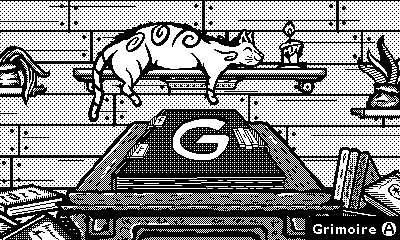
Figure 4. A cozy scene from Spellcorked.
The qualitative analysis has also identified qualities that oppose cozy game aesthetics or contravene the consumerist interpretation of coziness (see Table 2). These qualities highlight some of the salient tensions underlying Playdate as a platform. In the following sections, I will discuss games that include social critique and the games that feature high difficulty, which often goes in hand with nostalgic references.
|
Feature in opposition to cozy aesthetic |
Examples of games that contain the feature |
|
Serious or dark themes |
Echoic Memory -- philosophical science fiction Saturday Edition -- dark science fiction story |
|
Social critique |
Pick Pack Pup -- critique of big tech Reel Steal -- critique of economic inequality Skew -- critique of big tech in the base game |
|
High difficulty |
b360 Battleship Godios Crankin’s Time Travel Adventure Echoic Memory Hyper Meteor Omaze Zipper |
|
Time-sensitive mechanics |
Flipper Lifter Forest Byrnes: Up In Smoke Inventory Hero Pick Pack Pup Recommendation Dog |
Table 2. Examples of features contravening cozy aesthetics in Playdate games.
Coziness vs. Critique
The Edge reveal article ponders the contrarian and rebellious streak of Playdate, suggesting that “it’s counterculture, perhaps, in a friendly yellow form” [T17, p. 75]. At first sight, though, Playdate is more friendly than countercultural. Its promotional materials paint a bubblegum micro-utopia where purchasing an adorable piece of consumer electronics can bring genuine joy and happiness. The product launch video ad [T4] does not fail to mention that the company is based in Portland, Oregon, invoking the city’s reputation for quirkiness, weirdness and “cutely odd products” (Fowler & Derrick, 2018, p. 204). The PR texts position Playdate as being “different” rather than oppositional, as an additional console that will “deliver a jolt of fun in-between the times you spend with your phone and your home console” [T1]. Behind this happy façade, many things are left unsaid. The 1980s, which Panic employees enjoy reminiscing about, may not seem so bright when we realize that the ills of late capitalism have their roots in the Reaganite and Thatcherite economic and social policies. Likewise, Portland’s ascent as a site of quirky, independent and overwhelmingly white culture went hand in hand with gentrification and the displacement of the local African American population (Fowler & Derrick, 2018).
A closer look at the less prominent, fan-oriented material -- such as podcasts -- reveals both resistance and critique. On the production level, Panic has been addressing structural issues within the video game industry by taking both symbolic and real steps towards inclusiveness. While the console was designed almost exclusively by men, its promotional materials prominently feature women -- such as Christa Mrgan, who presents video updates and produces the podcast, and Arisa Sudangnoi, head of developer relations at Panic. Playdate has also closely collaborated with Sweet Baby, Inc., a narrative consultancy company best known as a target of an online harassment campaign accusing it of injecting “woke agenda” into video games (see Houle, 2024). Before this campaign -- while still largely unknown to the general public -- Sweet Baby had produced three Playdate games: Lost Your Marbles for Season 1, and Recommendation Dog and Reel Steal for the Catalog [6]. These were made in collaboration with junior developers from marginalized backgrounds, allowing them to gain experience and receive credit for their work. In the podcast, Panic’s Christa Mrgan concurs that “it really matters that talented, passionate people from all kinds of diverse and underrepresented backgrounds, get a shot [in the video game industry]” [T16]. Panic simultaneously encourages inclusivity in Catalog games, noting that curators will not accept content that “demeans any gender, gender identity and expression, sexual orientation, disability, mental illness, age, race, ethnicity, nationality, language, or religion” [T18].
On the level of individual games, we can find ones that coherently apply the cozy aesthetic to create feelgood experiences, and those that apply it in a dissonant way, combining coziness with critique (Waszkiewicz & Bakun, 2020). The former can be illustrated by Spellcorked, which presents a fantasy of “gig work” as chill, relaxing and devoid of anxiety. As one of the designers has put it, “there’s no money, no ‘failure’, and no stress” (splendorrrr, 2022). Depending on one’s stance on cozy gaming, this can be interpreted as both a utopia that is worth striving for, and an expression of “cruel optimism” that normalizes capitalist exploitation (Berlant, 2011; Scully-Blaker, 2024). Among the dissonant examples is the Season 1 match-three game Pick Pack Pup, which tells a story of a pup who gets a warehouse job in a giant e-commerce company called “Fetch.” It soon becomes clear that the company is exploiting its workers: the poor pup cannot take breaks and must work even on vacation (see Figure 5). Although the game is not particularly difficult, it imposes time limits in several levels (see Table 2), invoking the stressful nature of warehouse work. According to the game’s writer and graphics artist Arthur Hamer, the game’s story is “a thinly veiled allegory to Amazon,” inspired by his concern about Amazon’s practices of worker exploitation (Panic, 2022b). Similarly, Reel Steal is a heist game where you, according to the developers, “play as lovable thieves who use giant fishing rods to steal back priceless works of art that have been hidden away from the world.” During the game, you turn the crank to descend deep into vaults belonging to “evil billionaires that deserve to be stolen from” [T16].
Such anti-corporate sentiment is not uncommon in the indie game scene, which has always kept (at least rhetorical) distance from big business; games that critique worker exploitation and inequality naturally also appear on other platforms. What is different about Playdate is that these games form a part of the platform’s curated roster and that their creators voice their opinions in the official podcast. Playdate therefore openly invites players to understand cozy games not only in the consumerist sense, but also in the critical sense. To paraphrase Scully-Blaker, its wholesomeness is “more than skin-deep” (Scully-Blaker, 2024, p. 140).
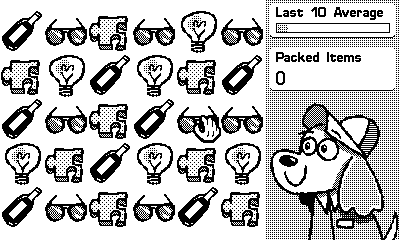
Figure 5. A gameplay screenshot from Pick Pack Pup.
Coziness vs. Nostalgia
While nostalgia is an important element of both cozy gaming and the cute aesthetic, Panic has been ambivalent about Playdate’s nostalgic appeal. According to Greg Maletic, “Playdate is in a way a kind of retro device with [a] black-and-white screen and so on, but the game mentality feels very modern to me…” (Dealessandri, 2024). On the one hand, Panic designers frequently refer to 1980s and 1990s product design, software publishing practices and the experience of playing games in those periods. On the other hand, Panic positions the platform as a part of the contemporary indie scene, in which they participate as publishers of high-profile titles like the Untitled Goose Game (House House, 2019).
This ambivalence can be explained by Garda’s conceptualization of “retro” and “neo” approaches to nostalgia in game design (Garda, 2013) -- which is in turn inspired by Boym’s distinction between restorative nostalgia, which aim to restore and revive the culture of the past, and reflective nostalgia, which evoke a longing for the old while adjusted to contemporary context (Boym 2001). The handheld console Analogue Pocket, visually similar to Playdate, can be considered “retro,” as it is used mostly to play old games for Nintendo and Sega consoles. On the other hand, Playdate is portrayed as bringing back sensations of surprise and joy common to 1980s gaming but adjusted to contemporary indie sensibilities. Therefore, it could be dubbed a “neo” Game Boy-style console.
The roster of games includes both “retro” and “neo” approaches. The “neo” approach can be illustrated by Eyeland, a game whose visual style harkens back to the Game Boy and the early 1980s British Horace series, but features casual mechanics and a cozy story about appreciating one’s home. On the other hand, the dedication to the “retro” approach may explain the high difficulty of several Playdate games that refer to the 1980s, a period when games tended to offer steeper challenges (Schweizer, 2016). One example is the Season 1 title b360, a Breakout (Atari, 1976) clone where the paddle moves around a circle rather than along a line. The game’s initial version was released around 2000 as a bonus game on Panic’s promotional CD-ROM. Interestingly, this 2000 version was already an example of restorative nostalgia as it pretended to be an emulation of a lost arcade game from 1982 (Panic, 2023). Besides the brick-breaking mechanics and the black-and-white retro visuals, the game also restores some of the difficulty of 1980s arcade games, requiring considerable precision with the crank controller.
Given Panic’s emphasis on accessibility and its evocations of reflective nostalgia, it is somewhat surprising that even the platform’s flagship title Crankin's Time Travel Adventure takes a restorative approach to difficulty. In the game, one rotates the crank to control the speed of a cute wind-up robot that needs to avoid hazards and arrive at a date with his female counterpart, Crankette (see Figure 6). The game -- co-designed by Keita Takahashi of the Katamari Damacy (Namco, 2004) fame -- neatly showcases the crank controller and has been used extensively in Playdate’s promotion. But as one progresses beyond tutorial levels, the game becomes uncompromisingly difficult, requiring pixel-perfect execution of memorized solutions and causing some players to quit in frustration (AmpleSamuel, 2024). The game sends mixed messages -- despite its cute visuals and cozy theme, it is a decidedly hardcore experience reminiscent of old arcade and home computer games and the more recent “masocore” platformers (Aardse, 2014).
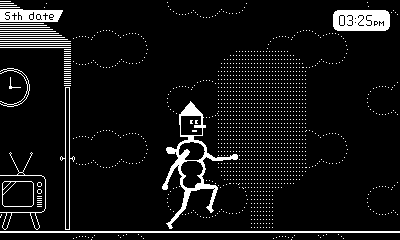
Figure 6. A gameplay screenshot from Crankin’s Time Travel Adventures.
Coziness vs. Commerce: A boutique distribution platform
By running the Catalog, Playdate has become a distribution platform akin to Steam or the Google Play store, albeit on a much smaller scale. As pointed out by critics of platform capitalism, platforms seek to maximize their profit and gain competitive advantage through “expansion of extraction, positioning as a gatekeeper… and enclosure of ecosystems.” (Srnicek, 2019, p. 98) With Playdate, Panic opposes this tendency, instead attempting to create an environment that is cozy for both developers and players and that does not require expansion to be sustainable.
Panic presents itself as a quintessentially indie company. The official Panic podcast describes it as “Portland's most lovable indie software- and game-publishing company” (Panic, 2020). Founded in 1997, the company started as a two-person outfit making development tools for Mac computers; it gradually entered games publishing and hardware production while expanding to around 30 employees. The official podcasts present Panic as a cozy, fun workplace and emphasize their reputation for quirky projects that are driven by curiosity rather than just profit. In other words, the company wants to remain lovable even as it engages in the platform business.
An explicit formulation of the values behind Playdate as a distribution platform can be found in Panic co-founder Steven Frank’s 2022 Gopher post reflecting on the release of Playdate; despite its relative obscurity, this document is the closest to a Playdate manifesto. Frank claims that if anything is truly “retro” about Playdate, it is its “philosophy”:
Platform owners need not be the gatekeepers of all content and money. A platform can thrive without needing to have their finger in every single pie. This is, in fact, the way it used to be by default in the industry for a very long time and everyone did quite well. […] We don't have to just sit by and watch as 2 or 3 massive corporations consume each other and gradually become the sole arbiters of what you can and cannot do with technology. [T12]
When speaking about “the industry,” Frank likely refers to the home computer software industry -- Panic’s original domain -- rather than the console games industry, which has been striving for platform control since at least Nintendo’s NES console (O’Donnell, 2011). While Playdate is aesthetically inspired by Nintendo consoles, its open distribution approach is a direct opposite of the tight control exercised by the Japanese company.
Developing, manufacturing and operating a hardware platform cannot be fueled by ideals alone. According to Frank, almost every employee of Panic has contributed to Playdate, along with several external consultants [T12]. However, Panic chose not to risk too much and never saw Playdate as its most important business. As Neven Mrgan put it in the Playdate podcast, “l don't think we're really sweating if this doesn't sell -- nobody loses their house, and we wouldn't make that kind of bet” [T13]. As a privately owned company with a diverse portfolio, Panic does not have to extract profit from Playdate in an overly aggressive manner.
Playdate currently generates revenue from hardware sales and the Catalog; the success in both streams depends on the appeal of Playdate software [7]. To ensure its quality, Panic recruited veterans from other, larger platforms: Nick Suttner, who had led independent game acquisition for Sony PlayStation and Oculus VR, and Arisa Sudangnoi, who had worked in developer relations at Steam. However, the Catalog is much smaller. According to Sudangnoi, its small size has allowed to create store that is “not too overwhelming” for the users and that allows Panic “to have a relationship with… developers” [T15]. As the Catalog submission form puts it, “it’s a boutique, not a warehouse” [T18]. The store is selectively curated and updated roughly once a month with only a handful of games. In line with cozy aesthetics, it is stylized as a magazine and accompanied by a breezy, optimistic tune. Purchases are made using the “crank to buy” interface, which envelops the financial transaction in a layer of coziness (see Figure 7) [8]. Compared to other game stores, the Catalog is distraction-free, devoid of pop-up ads, paid promotions and divisive user scores and reviews (see Cantone et al., 2024). It has gradually introduced common app store features such as wishlists and seasonal sales, making it more like Steam or the Nintendo eShop. However, thanks to its curated nature, it is still easy to discover individual games -- unlike on Steam, where overproduction of indie titles has caused a crisis of visibility (and, by extension, sales) that has been dubbed “Indiepocalypse” (Lipkin, 2019).
Panic aims to strike a balance between making profit and creating a cozy experience. The company takes a 25% cut of each sale, which is close to the industry standard of 30% (Thorhauge, 2023). However, Playdate also lets users “sideload” software they obtained elsewhere, either by downloading it for free or by purchasing it on services such as Itch.io. It is difficult to estimate how many regular users take advantage of “sideloading” (most likely a minority) [9]. However, according to a community survey, the feature is widely used by Playdate developers, 81% of whom sideload software from Itch.io (Vogelsang & Fraser, 2024). Sideloading therefore provides an important channel through which developers may send out their games for community testing; popular Playdate games like Bloom and Eyeland had started their life on Itch.io before they were featured in the Catalog.
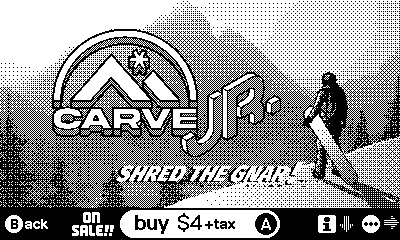
Figure 7. The Catalog page for Carve Jr., currently on sale.
Coziness vs. Commerce: A boutique production environment
As noted in the original Project Horseshoe document (Short et al., 2018), coziness may also apply to the production process. Playdate as a distribution platform and a game development ecosystem is cozy in part thanks to its scale. The relatively small user base means that Catalog developers cannot hope for a hit on the scale of Vampire Survivors (Poncle, 2021) that would generate massive profit. During its first two years, all Catalog developers earned the total of 1,043,187 USD after tax and Panic’s revenue cut (Playdate, 2025). Given the number of 262 available games, this amounts to the average net revenue of 3,981 USD per game. An example game mentioned in the Catalog One-year Anniversary Report, P-Racing (Risolvi Productions, 2023), sold 6,300 copies at a list price of 12 USD (when not on sale) within the first year of the Catalog’s existence [T2]. Given these figures, the title generated at most 75,600 USD of gross revenue, which would result -- after deducting sales tax and Panic’s 25% revenue share -- in about 54 000 USD net revenue for the developer, although the actual sum would be smaller because a portion of the purchases was for a reduced price [10]. This is one of the most expensive (and likely most successful) games and others will make significantly less. The lower financial stakes mean that the Playdate Catalog attracts semi-professional and hobby developers who make Playdate games as a pastime or a form of self-expression. Some of the more renowned designers -- such as Bennett Foddy or Keita Takahashi -- take part in the Seasons, which are more directly curated by Panic and may involve additional financial arrangements.
Beyond keeping the scale small, Panic portrays itself as a company that cares for its developers. Building on its experience of building development tools, it provides a free software development kit (SDK) and the Bitsy-inspired [11] Pulp engine. Developers are frequently featured in podcasts and video updates, often using self-produced footage captured in domestic settings [T7-T11] (see Figure 8). Ultimately, semi-professional and hobbyist developers will likely be the ones who can sustain the platform in the long run; maintaining a cozy and welcoming atmosphere may be therefore critical to Playdate’s survival. To attract fledgling developers, Panic also offers discounts to educational institutions (Panic, 2025b), a practice common among home computer hardware and engine producers rather than console manufacturers.
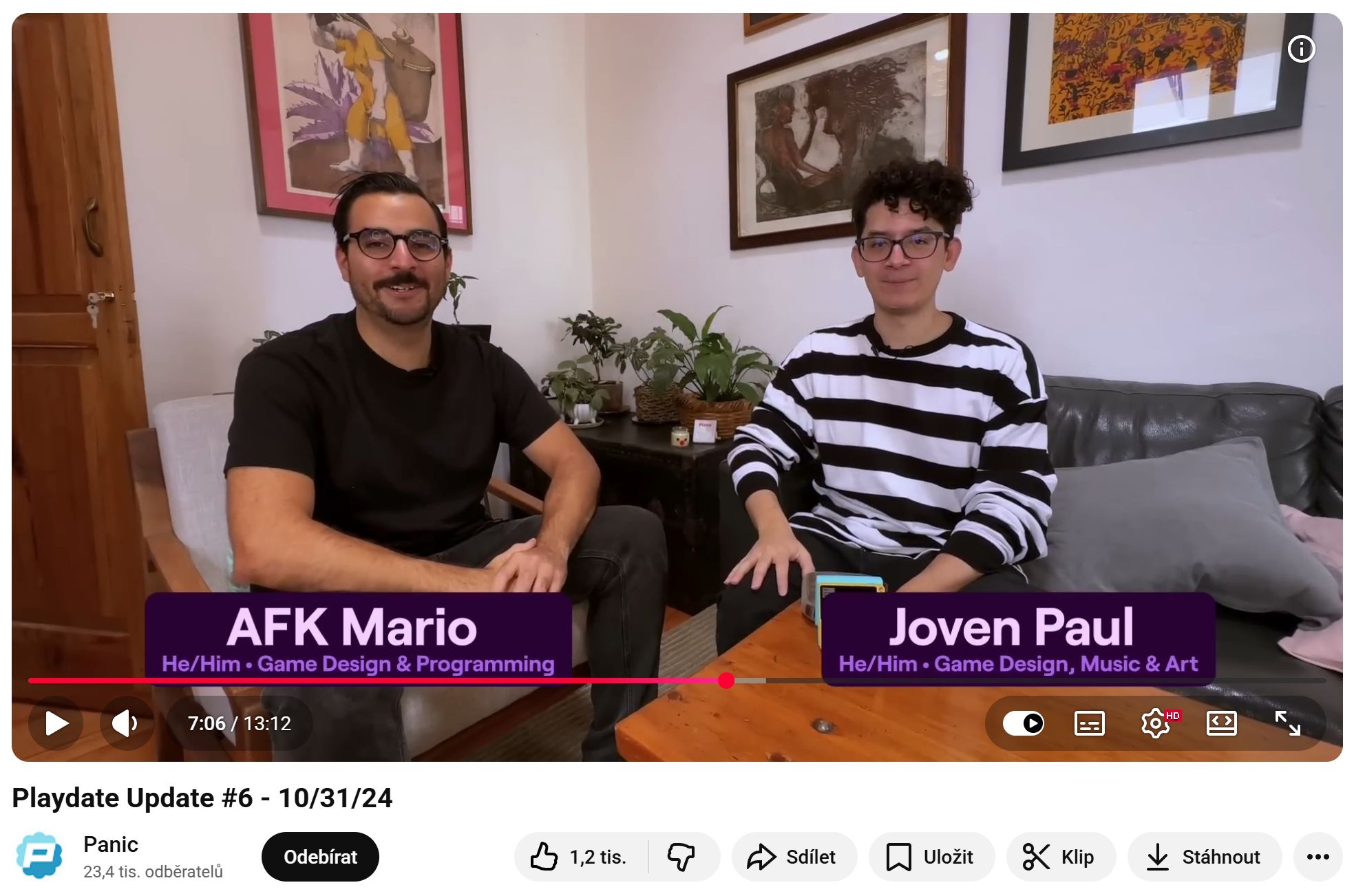
Figure 8. A still from a Playdate video update [T10], featuring indie developers Amano, based in Mexico. Click image to enlarge.
At the same time, relying on hobbyist developers may be at odds with the rhetoric of inclusivity because non-professional development is likely to attract structurally privileged demographic groups who can afford to do creative work with limited chances of turning profit. The Playdate dev community survey does, for example, show that respondents are 81.2% male, compared to 63% in the 2023 IGDA survey among game development professionals; 93.9% surveyed Playdate devs are based in North America or Europe (Vogelsang & Fraser, 2024; Weststar & Lentini, 2024) [12]. Besides offering free and user-friendly tools, Panic can address this -- and has done so -- by emphasizing inclusivity through curation. Season 2, for example, includes the game Taria & Como (Popseed Studios Inc & JuVee Productions, 2025), directed by the disabled artist Kip Henderson, which features a disabled protagonist and delivers scathing “social commentary” about healthcare [T11].
The era of platformized cultural production does not favor small players. As Nieborg and Poell note in their analysis of platformization, “network effects ultimately favor all but a handful of winners, thereby crowding out exceptions and alternatives” (2018, p. 4289). So far, this has not been the case with Playdate. Despite the post-covid downturn in the games industry, the Playdate has been -- according to Panic’s Greg Maletic -- “a success beyond what we imagined” (Dealessandri, 2024). In May 2025, Panic launched Season 2, featuring 12 new games that follow the established pattern of coziness, nostalgia and inclusivity.
At the same time, Playdate faces numerous practical and logistical challenges, many stemming from Panic’s limited leverage as a small-scale hardware producer. One after the other, their US shipping company and their hardware factory in Malaysia were acquired by larger companies and decided to drop their smaller customers, including Panic (Dealessandri, 2024). More generally, small-scale production generally results in higher unit prices. Between its launch and 2025, the price has risen from 179 USD to 229 USD, excluding the tariff mark-up introduced by Panic in response to the Trump administration’s import tariffs (Panic, 2025c). As a result, the Playdate is indeed a “boutique” product, relatively expensive when purchased as an addition to other consoles. This limits its audience to well-off indie game enthusiasts (and their friends and families) just as it limits the pool of developers to mostly financially secure hobbyists and semi-professionals. On this important point, Playdate diverges from casual and cozy games, which have been described as anti-elitist and accessible alternatives to hardcore AAA and competitive multiplayer games (Juul, 2009; Waszkiewicz & Bakun, 2020). Future research on Playdate should therefore focus specifically on users and developers to better explain their practices of playing or making games for the platform.
Conclusions
The article has shown that Playdate exhibits many features of cozy aesthetics. It is small and yellow; its games feature cartoon animals, nostalgic references and (very often) relaxing gameplay. On the webpage advertising 2025’s Fall Bundle (see Figure 8), it is even explicitly described as “the perfect console for cozy gaming with a buddy” (Panic, 2025a). Like cozy games, Playdate offers a temporary respite in an increasingly uncertain world; as Panic’s Steven Frank has put it, “I know everything is kind of depressing recently, but color is OK, shapes are OK, and joyfulness can be a feature” [T12]. At the same time, Playdate embodies the ambiguities and contradictions of cozy gaming: It flaunts quirky bubblegum aesthetics and a longing for 1980s consumer culture, while, at times, giving space to social critique. It provides a retreat to nostalgia, but the nostalgia sometimes undermines its coziness. Lastly, it has a distribution platform that uses techniques of platform capitalism while demonstrating care for the developer community. The concept of cozy game aesthetics has proven to be a suitable lens for analyzing Playdate precisely because of this ambiguity, not despite it.
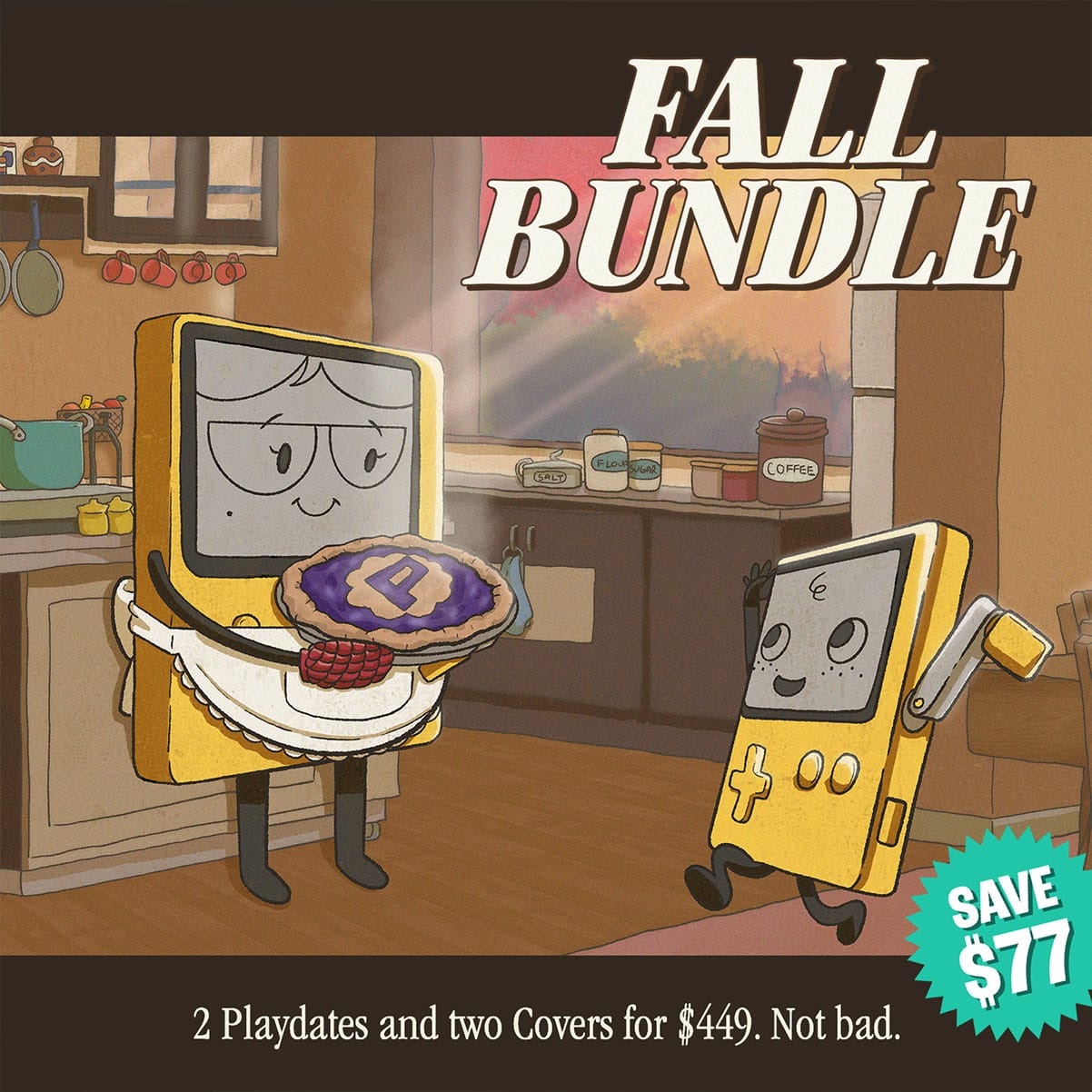
Figure 9. An illustration advertising the Fall Bundle. Note that the typeface at the bottom resembles Apple Garamond, a font used by Apple in their 1980s-1990s advertising and product design. Click image to enlarge.
From the perspective of platform studies, Playdate is an intriguing test case because of its resistance to the ongoing standardization of gaming platforms. It is, however, not the first small-scale alternative to the triumvirate of Sony, Nintendo and Microsoft, who have controlled the console market since the 2000s. The 2013 crowdfunded Android-based Ouya console launched to ample media coverage and great ambitions but did not build a sustainable ecosystem. Although the Ouya was designed with principles similar to Playdate’s -- such as platform openness -- its product and interface design were quite generic, making it difficult to stand out. At the same time, major manufacturers have also used elements of cozy aesthetic in their hardware and OS design -- especially Nintendo in its handhelds, the Wii, and to some extent the Switch. However, while the Nintendo Switch and Switch 2 are positioned as general-use devices for the mass market, Playdate is more of a boutique product. The latter’s coherent and unique aesthetic sets it apart from major platforms and may spark enthusiasm for the platform among users and developers.
The affective dimension of Playdate is a key part of its appeal because in strictly economic, utilitarian terms, being a Playdate user or Playdate Catalog developer is not an attractive value proposition: the hardware is fairly expensive given its specs and one cannot make a fortune making games for it. Instead, Playdate’s design and promotional materials cast it as cozy, cute, unique, and deserving of care and support. As a result, Playdate can be understood as a boutique micro-utopia suspended by the shared affect of coziness.
Playdate is in part born out of a longing for an imagined past of the game industry. As Steven Frank’s missives suggest, Playdate tries to invoke the practices of pre-platform-capitalism game industry by focusing on product design rather than market capture and on openness rather than control. This, however, is a somewhat rose-tinted reading of game history. The 1980s and 1990s game industry was already on the trajectory of consolidation and increasing control over creative process, exemplified by the very companies whose designs have inspired Playdate, such as Nintendo and Apple (see O’Donnell, 2011; Marques, 2005). The 1980s game industry was already exploitative towards its workers (Fleury, 2024) and the “containment of ludic imagination” already started in the mid-1980s (Kirkpatrick, 2017). On the one hand, Playdate embodies the fantasy of having the nice things capitalist game industry produced (such as the Nintendo Game Boy) without the bad ones (such as platform dominance, exploitation, and predatory monetization); to quote Andiloro (2024, p. 88), it offers us a “consumerist retreat into coziness.” But instead of just uncritically fetishizing the past, Panic have created a real, functional hardware and distribution platform built around nostalgic inspirations, and made inclusive curatorial decisions that would have been out of place in the 1980s. Similarly to UFO 50, Playdate is driven in part by the utopian impulse (Cartlidge, 2025). It takes a step beyond the conformist nostalgia and becomes a valuable social experiment, inviting players and developers to take part in “resistance through care” (Waszkiewicz & Tymińska, 2024). Ultimately, it shows that a platform can be cozy, with all the contradictions that entails -- albeit on the scale of a boutique product.
Endnotes
[1] The official materials published by Panic refer to Playdate without the definite article, both when referring to the device and the platform. I will follow this convention throughout this article. References to primary documents are listed in Appendix 1, see also Material and Methodology section.
[2] There are a few exceptions such as Shadowgate PD (Pixel Ghost, 2025), an authorized conversion of the 1980s adventure game Shadowgate (ICOM Simulations, 1987), or Blippo+ (Yacht et al., 2025), a full-motion video title that premiered in Playdate’s Season 2 and has been subsequently published by Panic for PC, Mac and Nintendo Switch.
[3] The notes have been taken between February and May 2025, and therefore do not reflect the changes implemented in the 3.0.0 version of the operating system, which was released on 1 October 2025 and which adds folders and other functionalities.
[4] Neven Mrgan is Croatian by birth. In English, he and his wife Christa both pronounce their last name as “Morgan.”
[5] The game was announced in 2021 but not released in time for the Catalog launch, therefore it is not included in my corpus.
[6] These Playdate titles are, in fact, the only games that Sweet Baby have developed on its own.
[7] Pre-orders for Season 2 started in April 2025, but they are handled as a part of the Catalog.
[8] Software can also be purchased from the Playdate website.
[9] The term “sideloading,” used officially by Panic, makes it sound dubious, possibly undermining the intention to make it a legitimate way of using the console.
[10] The sales tax is stated as 5% for sales in the U.S., and the 25% revenue share is deducted after taxes. Based on financial reports provided by an anonymous Playdate Catalog developer, the actual sales tax deduction can be slightly higher than 5%.
[11] Bitsy is a “little engine for little games, worlds, and stories” by Adam Le Doux (n.d.).
[12] However, the share of non-binary creators on Playdate (7.87%) is the same as in the IGDA survey (8%) (Vogelsang & Fraser, 2024; Weststar & Lentini, 2024).
[13] For references to Playdate games that formed the core of the research material, see Appendix 2.
References [13]
Aardse, K. (2014). The Other Side Of The Valley; Or, Between Freud And Videogames. Journal of Games Criticism, 1(1), 1-14.
AmpleSamuel. (2024, July 17). Review of Crankin’s Time Travel Adventure. Backloggd. https://www.backloggd.com
Anable, A. (2018). Platform Studies. Feminist Media Histories, 4(2), 135-140. https://doi.org/10.1525/fmh.2018.4.2.135
Atari. (1976). Breakout [Arcade]. Digital game published by Atari.
AtariArchives.org. (n.d.). What was Atari Program Exchange? Retrieved March 25, 2025, from https://www.atariarchives.org/APX/about.php
Ayres, L. (2008). Thematic Coding and Analysis. In L. M. Given (Ed.), The Sage encyclopedia of qualitative research methods (pp. 867-868). Sage Publications.
Berlant, L. G. (2011). Cruel optimism. Duke University Press.
Bódi, B. (2024). The Duality of Cozy Games: Cozy Agency, Neoliberalism, and Affect. Replay. The Polish Journal of Game Studies, 11(1), Article 1. https://doi.org/10.18778/2391-8551.11.04
Boym, S. (2001). The future of nostalgia. Basic Books.
Cantone, G. G., Tomaselli, V., & Mazzeo, V. (2024). Review bombing: Ideology-driven polarisation in online ratings: The case study of The Last of Us (part II). Quality & Quantity. https://doi.org/10.1007/s11135-024-01981-z
Cartlidge, J. (2025). Critical Nostalgia and the Utopian Impulse in UFO 50. Games and Culture, 15554120251329701. https://doi.org/10.1177/15554120251329701
ConcernedApe. (2016). Stardew Valley [Microsoft Windows]. Digital game designed by Eric Barone, published by ConcernedApe.
Dale, J. P., Goggin, J., Leyda, J., McIntyre, A. P., & Negra, D. (Eds.). (2017). The aesthetics and affects of cuteness [Introductory chapter]. In The aesthetics and affects of cuteness (pp. 1-34). Routledge. https://doi.org/10.4324/9781315658520
Dealessandri, M. (2024, April 23). We never really thought anyone was going to make a Playdate game. GamesIndustry.Biz. https://www.gamesindustry.biz/we-never-really-thought-anyone-was-going-to-make-a-playdate-game
Fernández-Vara, C. (2015). Introduction to game analysis. Routledge.
Fleury, J. (2024). From Superman to Swordquest: Atari and early video game labor exploitation. The American Journal of Economics and Sociology, 83(5), 955-965. https://doi.org/10.1111/ajes.12551
Fowler, E., & Derrick, M. (2018). Yipster Gentrification of Weird, White Portlandia. The California Geographer, 57, 189-212.
Garda, M. B. (2013). Nostalgia in Retro Game Design. Proceedings of DiGRA 2013 Conference. Proceedings of DiGRA 2013 Conference. https://doi.org/10.26503/dl.v2013i1.651
Gray, K. L. (2012). Intersecting Oppressions and Online Communities. Information, Communication & Society, 15(3), 411-428. https://doi.org/10.1080/1369118X.2011.642401
Houle, K. (2024). The Paranoid Style of Internet Politics: Gamer Backlashes and “Politics” as Imposition. POLIS: Sociology and Anthropology Undergraduate Journal, 1(1), Article 1.
House House. (2019). Untitled Goose Game [Microsoft Windows]. Digital game published by Panic.
ICOM Simulations. (1987). Shadowgate [Apple Macintosh]. Digital game published by ICOM Simulations.
Jameson, F. (2005). Archaeologies of the future: The desire called utopia and other science fictions. Verso.
Juul, J. (2009). A casual revolution: Reinventing video games and their players. MIT Press.
Kirkpatrick, G. (2017). Early Games Production, Gamer Subjectivation and the Containment of the Ludic Imagination. In M. Swalwell, H. Stuckey, & A. Ndalianis (Eds.), Fans and videogames: Histories, fandom, archives (pp. 19-37). Routledge.
Krzywinska, T., Brown, D., Ma, M., Belinskiy, A., & Bhui, K. (2025). Coziness in Games: Second Homes, Audiences, and Esthetics. Games and Culture, 15554120241310920. https://doi.org/10.1177/15554120241310920
Le Doux, A. (n.d.). Welcome to the world of bitsy! Bitsy. Retrieved April 29, 2025, from https://www.bitsy.org/
Lexaloffle. (n.d.). PICO-8 Fantasy Console. Retrieved March 24, 2025, from https://www.lexaloffle.com/pico-8.php
Light, B., Burgess, J., & Duguay, S. (2018). The walkthrough method: An approach to the study of apps. New Media & Society, 20(3), 881-900. https://doi.org/10.1177/1461444816675438
Lipkin, N. D. (2019). The Indiepocalypse: The Political-Economy of Independent Game Development Labor in Contemporary Indie Markets. Game Studies, 19(2). http://gamestudies.org/1902/articles/lipkin
Marques, I. da C. (2005). Cloning computers: From rights of possession to rights of creation. Science as Culture, 14(2), 139-160. https://doi.org/10.1080/09505430500110887
Montfort, N., & Bogost, I. (2009). Racing the Beam: The Atari Video Computer System. The MIT Press.
Mossmouth. (2024). UFO 50 [Microsoft Windows]. Digital game published by Mossmouth.
Namco. (2004). Katamari Damacy [Sony PlayStation 2]. Digital game directed by Keita Takahashi, published by Namco.
Ngai, S. (2015). Our aesthetic categories: Zany, cute, interesting. Harvard University Press.
Nicoll, B. (2019). Minor platforms in videogame history. Amsterdam University Press.
Nieborg, D. B., & Poell, T. (2018). The platformization of cultural production: Theorizing the contingent cultural commodity. New Media & Society, 20(11), 4275-4292. https://doi.org/10.1177/1461444818769694
O’Donnell, C. (2011). The Nintendo Entertainment System and the 10NES Chip: Carving the Video Game Industry in Silicon. Games and Culture, 6(1), 83-100. https://doi.org/10.1177/1555412010377319
Panic. (2020, January 15). Episode 1: Untitled Goose Game. Panic Podcast. https://podcast.panic.com/episodes/s01e01/transcript/
Panic. (2022a, April 12). Episode 1: The Story of Playdate. Playdate Podcast. https://podcast.play.date/episodes/s01e01/transcript/
Panic. (2022b, June 21). Episode 6: Pick Pack Pup. Playdate Podcast. https://podcast.play.date/episodes/s01e06/transcript/
Panic. (2023, March 1). Episode 24: B360. Playdate Podcast. https://podcast.play.date/episodes/s01e24/transcript/
Panic. (2024, March 14). Episode 29: Mars After Midnight. Playdate Podcast. https://podcast.play.date/episodes/s01e29/
Panic. (2025a). Fall Bundle. https://web.archive.org/web/20251018174725/https://play.date/shop/fall-bundle/
Panic. (2025b). Playdate for Education. https://play.date/education
Panic. (2025c, December 18). Tariff note -- Playdate Help. https://help.play.date/orders/tariffs/
Parker, F. (2020). Boutique indie: Annapurna interactive and contemporary independent game development. In Independent Videogames. Routledge.
Pimlott, M. (2007). The boutique and the mass market. In Vernet, David & L. de Wit (Eds.), Boutiques and Other Retail Spaces (pp. 1-15). Routledge.
Pixel Ghost. (2025). Shadowgate PD [Panic Playdate]. Digital game published by Pixel Ghost.
Playdate. (2025, April 10). A quick little note on how Playdate Catalog has done in the last two years [...] [Post]. Bluesky. https://bsky.app/profile/play.date/post/3lmi6mh2r222l
Poncle. (2021). Vampire Survivors [Microsoft Windows]. Digital game published by Poncle.
Pope, L. (2013). Papers, Please [Microsoft Windows]. Digital game designed by Lucas Pope, published by 3909 LLC.
Pope, L. (2024). Mars After Midnight [Panic Playdate]. Digital game designed by Lucas Pope, published by 3909 LLC.
Popseed Studios Inc & JuVee Productions. (2025). Taria & Como [Panic Playdate]. Digital game published by Popseed Studios Inc & JuVee Productions.
Preissle, J. (2008). Analytic Induction. In L. M. Given (Ed.), The Sage encyclopedia of qualitative research methods (pp. 15-16). Sage Publications.
Risolvi Productions. (2023). P-Racing [Panic Playdate]. Digital game published by Risolvi Productions.
Schweizer, N. (2016). Difficulty. In R. Guins & H. Lowood (Eds.), Debugging game history: A critical lexicon (pp. 109-117). MIT Press.
Scully-Blaker, R. (2024). The Politics of Wholesome Games: Conservative Comforts and Radical Softness. Configurations, 32(2), 129-143.
Short, T. X., Ordon, A., Hurd, D., Howe, C., Forbes, J., Eiserloh, S., Diaz, J., Cook, D., & Meiners, R. (2018, January 24). Cozy Games. Lostgarden. https://lostgarden.com/2018/01/24/cozy-games/
splendorrrr. (2022, July 4). Reply in the thread “I’m so bad at Spellcorked, it’s not even funny. I love it though!” [Reddit Post]. R/PlaydateConsole. www.reddit.com/r/PlaydateConsole/comments/vrk2sa/im_so_
bad_at_spellcorked_its_not_even_funny_i/
Srnicek, N. (2019). Platform capitalism (Reprinted). Polity.
Thorhauge, A. M. (2023). Games in the platform economy: Steam’s tangled markets. Bristol University Press.
Vogelsang, M., & Fraser, D. (2024, September 27). Playdate Community Census 2024. Playdate Community Wiki. https://playdate-wiki.com/wiki/Playdate_Community_Census_2024
Waszkiewicz, A., & Bakun, M. (2020). Towards the aesthetics of cozy video games. Journal of Gaming & Virtual Worlds, 12(3), 225-240. https://doi.org/10.1386/jgvw_00017_1
Waszkiewicz, A., & Tymińska, M. (2024). Cozy Games and Resistance Through Care. Replay. The Polish Journal of Game Studies, 11(1), Article 1. https://doi.org/10.18778/2391-8551.11.01
Weststar, J., & Lentini, A. (2024). Developer Satisfaction Survey 2023. IGDA. https://web.archive.org/web/20241220074419/http://igda-website.s3.us-east-2.amazonaws.com/wp-content/uploads/2024/05/01161842/2023-04-14_IGSA-DSS-2023_SummaryReport.pdf
Yacht, Telefantasy Studios, & Mierau, D. (2025). Blippo+ [Panic Playdate]. Digital game published by Panic.
Appendix 1
|
Appendix 1: List of primary documents |
|||||
|
No. |
Title |
Author(s) |
Date |
Type |
URL |
|
1 |
Playdate: Media Kit |
Panic |
2019-05-29 |
Press release |
https://web.archive.org/web/20190529102948/https://play.date/media/ |
|
2 |
Catalog One-year Anniversary Report |
Panic |
2024-05-02 |
Press release |
https://news.play.date/news/catalog-report-2024/ |
|
3 |
Make Games for Playdate |
Panic |
9/22/2020 |
Video ad |
https://www.youtube.com/watch?v=FH9HEmCwAvk |
|
4 |
Say Hello to Playdate |
Panic |
2021-06-09 |
Video ad |
https://www.youtube.com/watch?v=HdF3CnFvxg4 |
|
5 |
Playdate Update #1 |
Panic |
2021-06-08 |
Video update |
https://www.youtube.com/watch?v=DeWGukDrc1U |
|
6 |
Playdate Update #2 |
Panic |
2022-04-19 |
Video update |
https://www.youtube.com/watch?v=JPTX8GESzZY |
|
7 |
Playdate Update #3 |
Panic |
2023-03-07 |
Video update |
https://www.youtube.com/watch?v=Qr1_f-Q8Klw |
|
8 |
Playdate Update #4 |
Panic |
2023-11-08 |
Video update |
https://www.youtube.com/watch?v=2rctk5kTgnQ |
|
9 |
Playdate Update #5 |
Panic |
2024-02-28 |
Video update |
https://www.youtube.com/watch?v=1I9mO4pYBPI |
|
10 |
Playdate Update #6 - 10/31/24 |
Panic |
2024-10-31 |
Video update |
https://www.youtube.com/watch?v=wSNBCK5gIcY |
|
11 |
Playdate Update #7 |
Panic |
2025-04-17 |
Video update |
https://www.youtube.com/watch?v=H4faUwfDw5o |
|
12 |
First Playdates shipping |
Frank, Steve |
2022-04-18 |
Personal news update |
https://gopher.floodgap.com/gopher/gw?=stevenf.com+70+302f323032322d30342d31382d66697273742d706c617964617465732d7368697070696e672e747874 |
|
13 |
Episode 1: The Story of Playdate |
Panic |
2022-04-12 |
Podcast episode |
https://podcast.play.date/episodes/s01e01/transcript/ |
|
14 |
Episode 14: Playdate Mailbag #1 |
Panic |
2022-10-11 |
Podcast episode |
https://podcast.play.date/episodes/s01e14/transcript |
|
15 |
Episode 25: Catalog |
Panic |
2023-03-14 |
Podcast episode |
https://podcast.play.date/episodes/s01e25/transcript/ |
|
16 |
Episode 27: Reel Steal and Recommendation Dog |
Panic |
2023-04-11 |
Podcast episode |
https://podcast.play.date/episodes/s01e27/transcript/ |
|
17 |
Small wonder |
Simpkins, Jen |
2019-05-23 |
Magazine article |
|
|
17 |
Designing for Playdate, version 2.6.2 |
Panic |
undated |
Developer instructions |
https://sdk.play.date/designing-for-playdate |
|
18 |
Playdate Catalog Submissions |
Panic |
undated |
Developer instructions |
https://panic-inc.typeform.com/catalog |
Appendix 2
|
Appendix 2: Game list |
|||
|
Title |
Type |
Developer |
Year of release |
|
b360 |
Season 1 |
Panic |
2022 |
|
Battleship Godios |
Season 1 |
TPM.CO SOFT WORKS |
2022 |
|
Boogie Loops |
Season 1 |
May-Li Khoe and Andy Matuschak |
2022 |
|
Casual Birder |
Season 1 |
Diego Garcia |
2022 |
|
Crankin's Time Travel Adventure |
Season 1 |
uvula |
2022 |
|
Demon Quest 85 |
Season 1 |
Crooked Park |
2022 |
|
Echoic Memory |
Season 1 |
Samantha Zero |
2022 |
|
Executive Golf DX |
Season 1 |
davemakes |
2022 |
|
Flipper Lifter |
Season 1 |
Serenity Forge |
2022 |
|
Forest Byrnes: Up In Smoke |
Season 1 |
Nels Anderson |
2022 |
|
Hyper Meteor |
Season 1 |
Vertex Pop |
2022 |
|
Inventory Hero |
Season 1 |
Panic |
2022 |
|
Lost Your Marbles |
Season 1 |
Sweet Baby Inc. |
2022 |
|
Omaze |
Season 1 |
Gregory Kogos |
2022 |
|
Pick Pack Pup |
Season 1 |
Nic Magnier, Arthur Hamer and Logan Gabriel |
2022 |
|
Questy Chess |
Season 1 |
Dadako |
2022 |
|
Ratcheteer |
Season 1 |
Shaun Inman, Matthew Grimm, and Charlie Davis |
2022 |
|
Sasquatchers |
Season 1 |
Chuck Jordan |
2022 |
|
Saturday Edition |
Season 1 |
Wild Rose |
2022 |
|
Snak |
Season 1 |
stfj (Zach Gage) |
2022 |
|
Spellcorked |
Season 1 |
Jada Gibbs, Nick Splendorr and Ryan Splendorr |
2022 |
|
Starsled |
Season 1 |
Panic |
2022 |
|
Whitewater Wipeout |
Season 1 |
Chuhai Labs |
2022 |
|
Zipper |
Season 1 |
Bennett Foddy |
2022 |
|
A Joke That's Worth 0.99 |
Catalog |
kamibox |
2023 |
|
Bloom |
Catalog |
RNG Party Games |
2023 |
|
Carve Jr |
Catalog |
Chuhai Labs |
2023 |
|
Direct Drive |
Catalog |
DAC vector |
2023 |
|
Down the Oubliette |
Catalog |
RDK |
2023 |
|
Eyeland |
Catalog |
Ron Lent |
2022 |
|
Grand Tour Legends |
Catalog |
IORAMA |
2023 |
|
Hidey Spot |
Catalog |
Neven Mrgan |
2023 |
|
Playmaker |
Catalog |
Dustin Mierau |
2023 |
|
Recommendation Dog |
Catalog |
Sweet Baby Inc. |
2023 |
|
Reel Steal |
Catalog |
Sweet Baby Inc. |
2023 |
|
Skew |
Catalog |
Oiffy |
2023 |
|
Swap Machina |
Catalog |
NaOH & Zion D. Hill |
2023 |
|
TapewormDiscoPuzzle |
Catalog |
lowtek Games, Itd |
2023 |
|
The Botanist |
Catalog |
Cadin Batrack |
2023 |
|
Word Trip |
Catalog |
Shaun Inman |
2023 |